
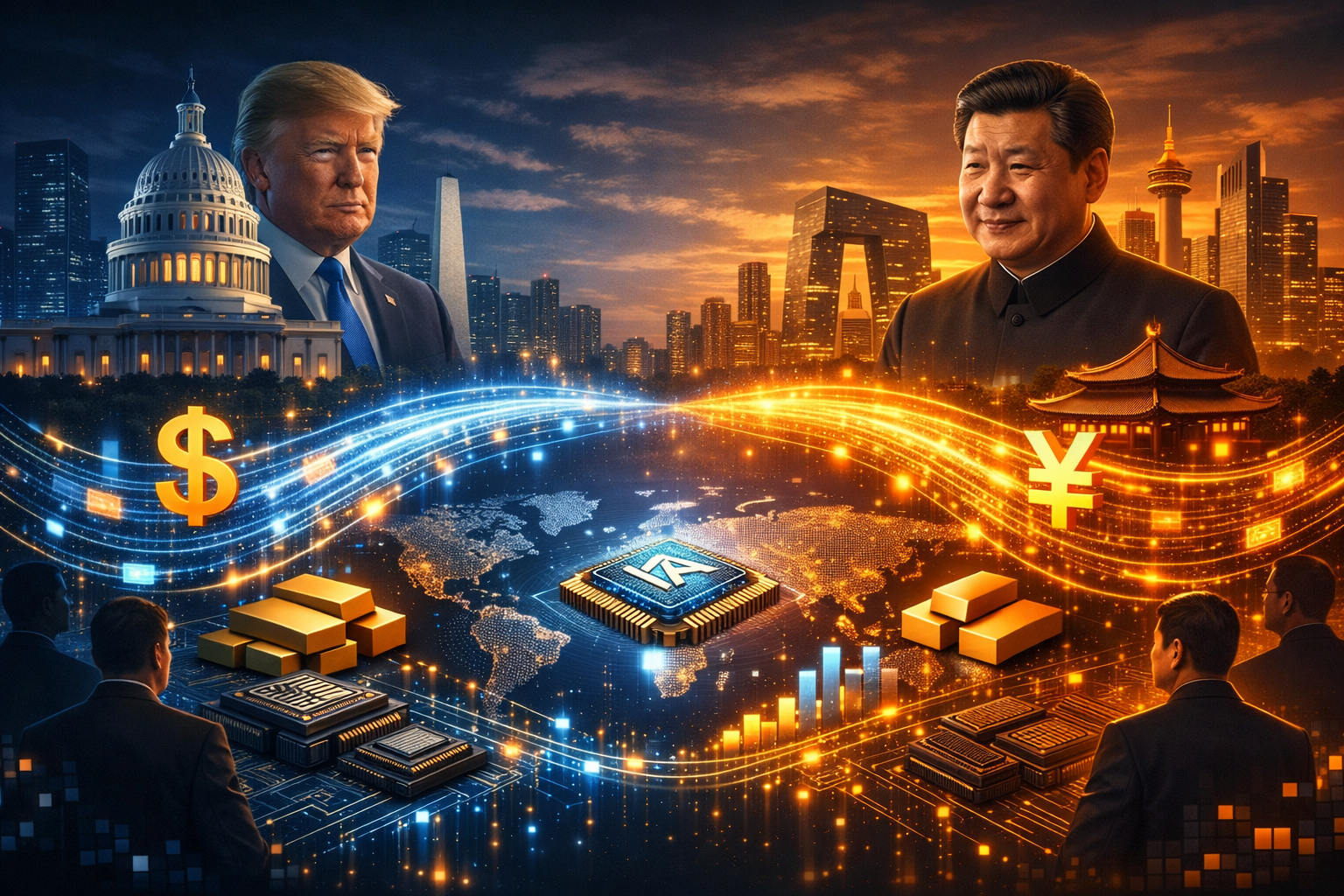
The invisible infrastructure behind diplomacy that defines who will control capital and energy in the next decade.
⚠️ Authority Warning: This content is strictly educational and informative. TecnFinanças does not provide buy, sell, or investment recommendations. The focus is on technological sovereignty and financial freedom. Consult a qualified professional before investing.
In this strategic report:
- Diplomatic Backstages: Business Above Geopolitics
- De Facto Sovereignty: Corporations Rivaling States
- The Weaponization of Currency: The Erosion of the Dollar Standard
- Reserve Duality: The Weight of the Yuan in the Regional Scenario
- The Triad of Real Power: Semiconductors, Energy, and Settlement
- Practical Consequences for Brazilian Wealth
The dynamics of global power at its current stage have reached an inflection point that challenges conventional analysis. While public attention focuses on rhetorical tensions, the 2026 diplomatic meeting between Washington and Beijing silently redrew the map of financial sovereignty.
Here is the detail most ignore: the true struggle is not for territories, but for invisible infrastructure. By the end of this report, you will understand why control over your wealth today depends more on access to computational power than on domestic fiscal policies.
Diplomatic Backstages: Business Above Geopolitics {#diplomatic-backstages}
The May 2026 diplomatic meeting marked a historical precedent. However, the narrative of “imminent confrontation” was subverted by a technical reality: the terms of coexistence between the powers were negotiated through AI chip export licenses and cybersecurity protocols.
Understand the mechanism behind this: access to computational processing power is now the most valuable diplomatic asset in the world. The inclusion of semiconductor industry leaders in these backstage negotiations underscores that modern diplomacy is, in fact, the management of technological supply chains. Without high-end chips, national economies become blind.
To understand how this infrastructure is being protected against future threats, see our analysis on Post-Quantum Cryptography and financial data security.
De Facto Sovereignty: Corporations Rivaling States {#de-facto-sovereignty}
A powerful image emerged from this meeting: the presentation of 18 of the world’s top executives to Beijing’s leadership. These names hold de facto sovereignty over data and capital. Their corporations operate ecosystems that transcend national legislations.
In 2026, the market value of giants like Nvidia reached historical levels that rival the GDP of major G7 national economies. This proves that modern financial sovereignty is no longer tied solely to geographic territories, but to the possession of critical patents and Artificial Intelligence infrastructure.
But there is a catch. If governments impose tariffs, these corporations have the scale to adjust global production chains in real-time. They are the guarantors of economic stability, becoming deep partners in Chinese development and, simultaneously, pillars of American national security.
💧 Information Drop: The Corporate Nation-State
The possession of “Digital Twins” and cloud infrastructure allows these companies to simulate economic impacts even before governments make decisions. They don’t just follow the rules; they define the field where the rules are written.
The Weaponization of Currency: The Erosion of the Dollar Standard {#currency-weaponization}
Currency remains the central pillar, but 2026 data reveals that the foundations are being tested. The trajectory is one of measurable erosion. According to J.P. Morgan reports, the dollar’s share in global reserves has dropped to levels not seen since the 90s.
The driving mechanism behind this movement was the “weaponization” of currency. The freezing of international reserves served as a wake-up call for nations to seek alternatives outside of Washington’s exclusive orbit. This scenario drives the development of sovereign digital currencies, such as Drex in Brazil, which redefines the programmable economy.
Reserve Duality: The Weight of the Yuan in the Regional Scenario {#reserve-duality}
Despite Beijing’s industrial weight, the internationalization of the Yuan faces structural barriers, such as capital controls. However, in a regional context, the Chinese currency has gained strategic space. In Brazil, the Yuan’s share in international reserves has surpassed traditional currencies like the Euro.
This does not signal a total replacement, but a diversification of sovereignty. Investors must understand that the fragmentation of the global financial system into technological blocs requires a reassessment of wealth protection. Security is no longer in a single safe haven, but in resilience across jurisdictions.
The Triad of Real Power: Semiconductors, Energy, and Settlement {#power-triad}
Contemporary geopolitical power rests on an inseparable triad:
- Semiconductors (Chips): Without them, data processing and AI cease. “Technological mercantilism” ensures that control of these components dictates the progress of entire nations.
- Energy and Transition Matrices: Mutual dependence on strategic mineral resources forces a truce diplomacy. To understand the impact of this on mobility and logistics costs, see our report on Solid State Batteries.
- Settlement Infrastructure: Those who control the system where value is transacted capture the real value of physical production. This is where technologies like Real World Asset (RWA) Tokenization enter as tools for freedom.
💧 Information Drop: Gold as a Systemic Hedge
Central banks, including the Central Bank of Brazil, have drastically increased their gold reserves in recent years. The metal is no longer seen just as a store of value, but as “insurance against systemic failure” in the digital infrastructure.
Practical Consequences for Brazilian Wealth {#practical-consequences}
You might ask: “What does the Beijing meeting change in my daily life in Araranguá or São Paulo?” The answer is: everything.
Geopolitical instability between these powers generates immediate consequences:
- Exchange Rate Volatility: The monetary dispute pressures the Brazilian Real (BRL). Investors 100% exposed to the local currency are vulnerable to variations that erode global purchasing power in minutes.
- Pressure on Interest Rates and Inflation: Since Brazil depends on imported technology and agricultural inputs linked to the Chinese and American markets, any disturbance in the “invisible infrastructure” reflects on supermarket shelves and the SELIC rate.
- Acceleration of Bitcoin and Power Assets: Notice that the market has begun to price assets that do not depend on the jurisdiction of either bloc. Bitcoin and companies holding a technological monopoly become “islands of sovereignty.”
To ensure autonomy, the sovereign investor must seek international diversification and exposure to real assets, protecting themselves from the volatility caused by diplomatic narratives.
At the end of this analysis, it is evident that control of the world occurs where capital and cutting-edge technology meet. If the corporations present at the Summit define the rules, your investment portfolio must reflect this hierarchy of power.
Provocative question: In a world where tech corporations rival national GDPs, do you feel safer trusting your retirement to your country’s currency or to the systems that control the intelligence of the future?
Sources and References:
- Central Bank of Brazil (BCB): International Reserves Management Report
- NIST: Post-Quantum Cryptography Standards and Global Infrastructure
- J.P. Morgan: 2026 Market Outlook – Global Capital Flows
- World Gold Council: Central Bank Gold Reserves Trends 2026
- Bloomberg Intelligence: Tech Sourcing and Global Supply Chain Analysis